
Compare the websites of several competing supply chain software companies or logistics providers. You may find similar promises: greater efficiency, improved visibility, seamless integration, better customer service and, of course, AI-powered everything.
Each company may deliver those benefits differently. Yet a buyer scanning the websites can leave with the impression that the alternatives are largely interchangeable. If your homepage messaging could belong to your competitor, that is a positioning problem. It becomes a commercial problem when the buyer cannot explain why your particular approach deserves consideration.
Why Generic Benefits Weaken Supply Chain Software Positioning
“Improved visibility” tells buyers what they might gain. It does not establish where your offering has an advantage.
Imagine a software provider whose strongest capability is reconciling inventory exceptions across disconnected warehouse systems. A general visibility message hides the circumstances in which that capability matters most.
A more useful explanation would identify the situation: operations teams working across several warehouse systems, reconciling exceptions manually, and making allocation decisions with inconsistent information.
The message can then explain the provider’s approach and show evidence of its effect. The buyer has something concrete to evaluate.
The same applies to services. “Responsive customer service” becomes more meaningful when a provider explains how exceptions are escalated, who owns resolution, and what customers can expect during a disruption. Effective supply chain brand positioning connects capability directly to these operating realities.
How to Position Supply Chain Solutions for the Buying Committee
Your contact may understand the difference after a demonstration. The next hurdle is carrying that understanding to people who were absent.
Gartner research shows B2B buyers spend only 17% of their total purchase process meeting with potential suppliers. The rest goes to independent research, internal discussion with the buying group, and making sense of competing claims. When your team isn’t in the room, colleagues across different departments evaluate that information through their own priorities.
An operations leader may care about disruption and execution. IT may care about integration, security and maintenance. Finance may ask whether the benefit justifies the investment. Procurement may compare contractual exposure and supplier reliability.
These audiences need a consistent core position, supported by arguments relevant to their responsibilities. Those arguments should answer the questions supply chain buyers need answered before backing a new initiative. Giving everyone the same broad benefits statement leaves the champion to translate it alone.
Try asking a contact: “How would you explain our difference to your finance or technology team?” The answer can reveal whether your positioning survives beyond the presentation.
A 3-Step Supply Chain Software Differentiation Check
To evaluate whether your positioning holds up against market alternatives, run this practical check:
- Run the Name-Removal Test: Remove your company name from your main value proposition. Could a competitor use the same words without changing much?
- Anchor the Mechanism to a Specific Situation: Identify the buyer situation in which your approach is especially valuable. Explain the operational mechanism behind the advantage, then attach evidence that supports the claim.
- Benchmark Against True Alternatives: Compare your explanation with the alternatives a buyer actually considers. Those alternatives can include an incumbent supplier, an internal process, or continuing as they are.
The objective is a clear, defensible reason for a particular buyer to choose you. A memorable phrase helps only if it carries that reason.
Find Out Where Your Positioning Advantage May Be Getting Lost
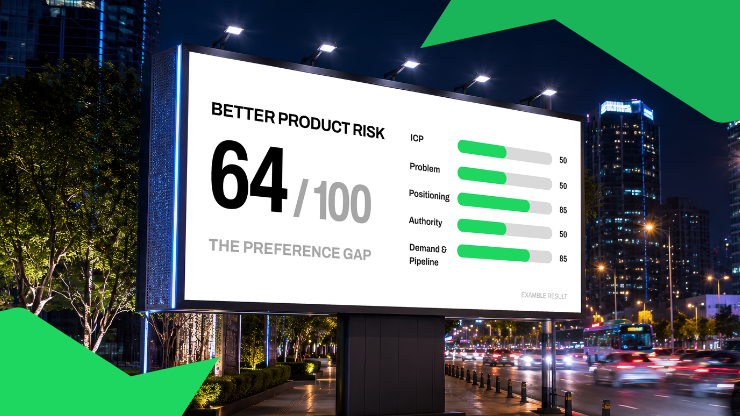
Pesti’s Better Products Lose Every Day Assessment examines five parts of the GTM system: ICP, buyer problem, positioning, authority and influence, and demand and pipeline.
Answer 10 questions to see your risk profile and the dimensions that may need attention. Your full results are available before you share contact details.