

Most people think of email marketing as just another newsletter—a routine drop into already cluttered inboxes. But in supply chain, we’ve seen it work very differently. At Pesti, we’ve been running Supply Chain Radar (SCR)—a weekly newsletter now read by 68,000 subscribers—and recently, a simple team debate turned into a live experiment.
The question? Which day and time actually works best for sending SCR?
What started as back-and-forth opinions (and even a small bet) became a test we ran over several weeks. The results surprised us—and gave us insights worth sharing with anyone trying to make email marketing work in this industry.
This isn’t the one right way. There are many. But here’s what worked for us.
How It All Started: A Debate, A Bet, and a Newsletter
It all began with a spirited debate in our team:
- One camp swore by Sundays—the perfect time to catch readers when they’re relaxed.
- Another insisted on Mondays—fresh week, fresh inbox.
- A third backed Thursdays—the reliable midweek sweet spot.
The discussion got so animated that it turned into a bet. Nothing monetary, but the stakes were clear: whoever guessed the winning day would earn ten minutes of glory—a round of praise from the team during our weekly stand-up.
There was only one way to end the argument: put Supply Chain Radar (SCR) to the test and let the data decide. What started as a playful wager quickly turned into a weeks-long experiment to find out which day truly worked best—and who, among us, would finally win the bragging rights.
So, Which Day Worked Best?
We ran the experiment. We tracked open rates and clicks. And here’s what happened:

What we learned:
- Sunday dominated with the highest open rate → people really do check email on weekends.
- Monday came through with the highest clicks → weekday readers are more action-oriented.
- Thursday was steady, but not exceptional.
- Friday underperformed, especially on clicks.
For a brief moment, we thought Sunday was the clear winner. To be sure, we even went back and ran SCR on Sundays for three weeks straight. But as the tests continued, Sunday’s edge gradually leveled out—open rates returned to the average.The real takeaway? There’s no single “magic day.” What matters is finding patterns that align with your goals. For us Monday’s been working the best.
- Want maximum visibility (opens) → Sunday.
- Want deeper engagement (clicks) → Monday.
- Want to avoid underperformance → Skip Friday.
That said, this is what worked for us with SCR and our 68,000 supply chain readers. Your audience, your content, and your context may be completely different. The best recommendation? Run your own tests—the data will tell you more than any rule ever could.
What about the best time of day?
Our campaigns showed that mid-morning (between 7 AM–8 AM EST) consistently performed best across regions. Early mornings had lower engagement, and late evenings only worked if paired with big announcements.
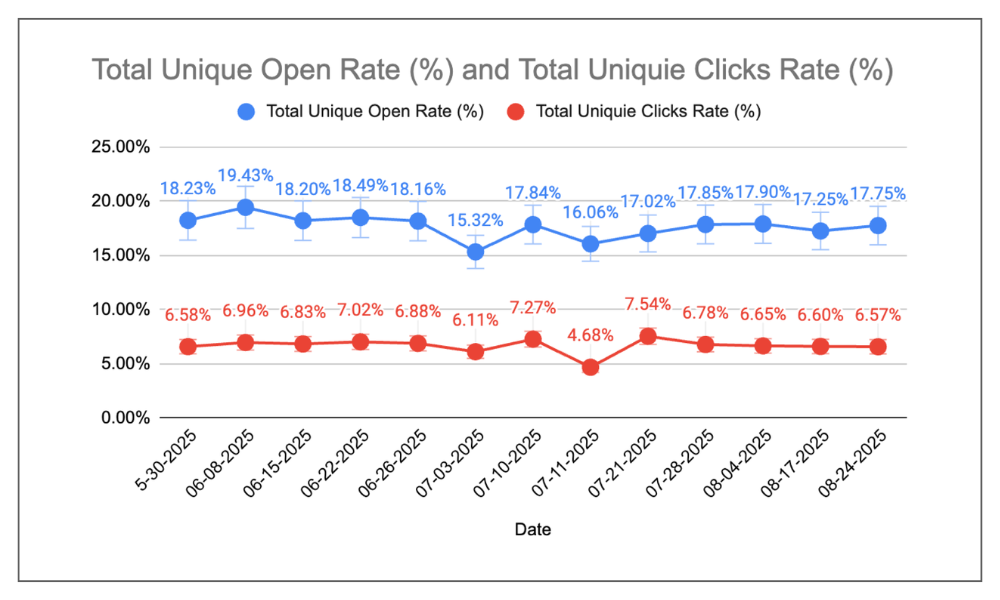
Beyond Timing: What Really Works in Supply Chain Email Marketing
Timing plays a role, but it’s only part of the story. What truly makes an impact is what you say and how you say it. Supply chain professionals are busy, pragmatic, and quick to tune out generic noise. The real differentiator isn’t just when your email lands—it’s whether the content is relevant, useful, and delivered in a way that resonates with their priorities.
Here are a few things we’ve seen consistently move the needle in newsletters and campaigns:
1. Niche Relevance, Not Generic Insights Campaigns that spoke directly to supply chain realities always outperformed “broad business” advice. For instance:
- A port disruption update tailored to exporters generated a 30% higher open rate than generic market commentary.
2. Data-Backed Storytelling That Resonates Some of our best-performing newsletters didn’t just share information—they told a story with data.
- When we ran the 2025 Dock & Yard Market Report and framed it around what delays meant for shippers, around 40% of the 140 leads came directly through campaign-driven clicks.
- Similarly, linking global trade disruption data with inventory strategy sparked stronger engagement than plain “state of industry” notes.
3. Personalization Beyond First Names Personalization worked best when tied to roles and pain points—not just first names.
- Example: A subject line like “What port delays mean for Indian exporters this quarter” delivered significantly higher open rates than a generic “Global Supply Chain Outlook.”
4. Consistency Over Gimmicks Consistency builds trust. Weekly or biweekly sends with clear value retained subscribers far better than irregular “big blasts.” One clear trend we saw: unsubscribe rates stayed below 0.1% per send when cadence was predictable.
5. Segmented Messaging: Openers vs. Non-OpenersOne of the most impactful tactics has been tailoring follow-ups based on engagement. Looking at the September campaigns as a whole:
- Openers consistently drove strong performance, averaging around 55% unique open rate and 25–30% unique click rate.
- Non-Openers, by contrast, only showed ~2–4% opens and under 1% unique click rate when re-targeted.
Across campaigns, subscribers who engaged at least once continued to perform 8–10x better than those who didn’t. This shows that instead of investing heavily in re-engaging cold audiences, greater ROI comes from nurturing engaged readers with richer content—while using short, sharp reminders for non-openers to either spark activity or naturally filter out over time.
This approach means our overall active audience may be smaller—but it’s far more responsive. After all, what good comes from talking to people who never open?
Key Takeaways
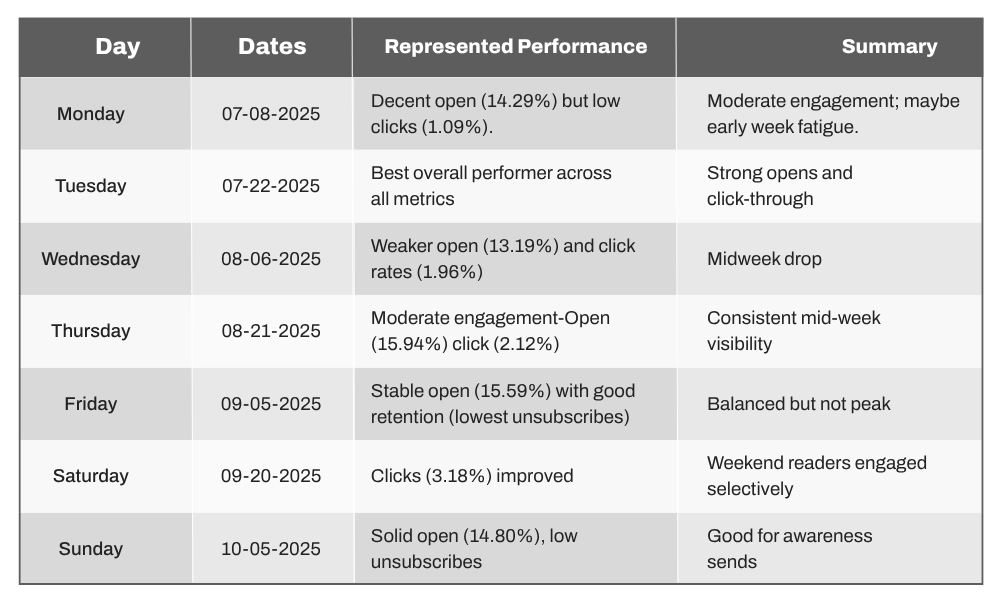
After running our initial tests with Supply Chain Radar, we decided to replicate the experiment for a different audience segment—subscribers focused on Ocean Freight Radar. The goal was to see whether engagement patterns held true across niches or if behavior varied by audience type. Here’s what we concluded:
- Best Day to Send: Tuesday — consistently highest across open, click, and total engagement metrics.Steady Performers: Thursday & Friday — stable engagement with low unsubscribe rates.
- Recommended Send Window: Between 5:00 AM and 8:00 AM EST — aligns with the top-performing campaign timings.
Email marketing works in supply chain—but only if done with precision. Here’s how it worked for us:
Day-of-Week Performance Summary
In other words, email marketing is still relevant. It’s still the best way to reach your prospects. However, there’s no silver bullet. You have to experiment to find the right strategy, and put effort into building strong content. Skip these steps and you might as well not bother to begin.
At Pesti, we’ve taken the guesswork out of email marketing by combining industry-specific insights with data-driven execution. From finding the right day and time, to crafting content that supply chain leaders actually want to read, we focus on creating campaigns that don’t just land in inboxes—they spark conversations and drive measurable outcomes.
Ready to move beyond “just another newsletter”? Let’s build an email strategy that works as hard as your supply chain. Talk to us today.